How to Compare Seasoning Suppliers: A 12-Point Factory Checklist
Most seasoning suppliers look identical on a quotation sheet. The differences that decide whether your line runs smoothly for the next three years are the ones that never appear in the price column. Here is the checklist to use before you send an RFQ.
Compare seasoning suppliers on twelve verifiable points across four groups: the technical fit of the product (points 1–3), the stability of the production system (points 4–6), the commercial structure of the deal (points 7–9), and the support you get after the order (points 10–12). Price is a result of these twelve, not an input you can compare first.
If you only have time to check three things, check these: a baseline yield trial on your own chicken, the actual certificate scope — not the certificate logo, and whether the supplier will put your flavour standard in writing.
01Why supplier comparison goes wrong
A purchasing manager at a fried-chicken plant typically receives five quotations for the same category — say, a chicken marinade. All five arrive as a price per kilogram, a minimum order quantity, and a lead time. They look comparable. They are not.
The problem is that seasoning is not a commodity. A marinade is a formulation plus a process recommendation plus a quality control regime, delivered as a powder or paste. Two suppliers can quote the same price per kilogram and deliver completely different cost per finished kilogram, because the ingredient that matters is not the seasoning price — it is how much saleable product comes out of the other end of your fryer.
We have seen this play out repeatedly in Southeast Asian poultry processing, where material cost dominates and margins are thin. A supplier that quotes 8% less per kilogram but holds 2% less water in the meat can easily cost you more per finished unit. That is the trap. The checklist below is designed to expose it.
02Three common reasons comparisons fail
Reason 1: You are comparing quotes, not systems
A quotation describes a product. What you are actually buying is a production system — the formulation, the usage ratio, the recommended process parameters, the batch-to-batch tolerance, and the technical response when something drifts. A quotation cannot show you any of that. A trial can.
Reason 2: Certificate logos are being treated as certificate scope
"ISO certified" and "HACCP certified" are almost meaningless on their own. What matters is the scope — which facility, which product categories, which markets the certificate is recognised in. A Halal certificate issued under one national scheme may not be accepted by the authority in the market you are exporting to. This is the single most common compliance surprise in Southeast Asian food export.
Reason 3: Nobody defined what "the same" means
When a factory evaluates a new marinade by taste-testing it once, the comparison is subjective and non-reproducible. Without a written sensory and physical baseline — colour after marination, yield percentage, texture after freezing and reheating — the second batch will be argued about rather than measured.
03The 12-point comparison checklist
Score each supplier 1–5 on every point. Anything scoring 1 or 2 in group 2 (production stability) should be treated as a hard stop regardless of price.
Group 1 — Technical fit of the product
| # | Point | What to ask and what a good answer looks like |
|---|---|---|
| 1 | Baseline yield on your raw material | Run the trial on your chicken, not a sample the supplier prepared. Measure cooked yield percentage against your current supplier. A good supplier will propose this test themselves. |
| 2 | Process compatibility | Ask for the recommended usage ratio and process parameters in writing — marination ratio, vacuum tumbling time and pressure, marination temperature and holding time, freezing regime. A supplier who cannot state these numbers is selling you a flavour, not a solution. |
| 3 | Behaviour after freeze–thaw | For frozen product, the flavour and texture must survive a freeze–thaw cycle. Test specifically for water purge after thawing, colour shift, and texture change after reheating. This is where cheap formulations separate from engineered ones. |
Group 2 — Stability of the production system
| # | Point | What to ask and what a good answer looks like |
|---|---|---|
| 4 | Batch-to-batch tolerance | Ask for the stated tolerance on key parameters (colour, viscosity, salt content, particle size). Ask how many batches per year fall outside tolerance and what happens when they do. Vague answers here predict future complaints. |
| 5 | Actual certificate scope | Request the certificate document, not the logo. Check: issuing body, facility address, product scope, validity date, and — critically — whether that scheme is recognised in your destination market. |
| 6 | Capacity and lead time realism | Match the supplier's stated capacity against your peak-season demand, and add your own growth plan. A supplier running near maximum capacity in a seasonal peak is a supply risk, not a cost saving. |
Group 3 — Commercial structure
| # | Point | What to ask and what a good answer looks like |
|---|---|---|
| 7 | MOQ against your real order pattern | Compare the MOQ to what you actually consume, not what you wish you consumed. If MOQ is far above your monthly usage, you are buying warehousing and shelf-life risk, not efficiency. |
| 8 | Packaging that survives the shipment | Ask about the inner liner, moisture barrier and pest protection. For tropical markets, humidity ingress during transit and storage is a real cause of caking and flavour drift. Ask what packaging is recommended for your climate. |
| 9 | Total landed cost, quoted in your terms | Ask for a quotation on the Incoterm you actually buy on. If you import, insist on a cost breakdown you can verify — product, packaging, inland freight, port charges, sea freight, insurance. A price that is only comparable at the factory gate is not comparable. |
Group 4 — Support after the order
| # | Point | What to ask and what a good answer looks like |
|---|---|---|
| 10 | Application support, not just delivery | Ask who will help you when a batch behaves unexpectedly — a salesperson, or a technical contact who can discuss your line parameters. The difference shows up in the first real problem. |
| 11 | Customisation path | Ask what the process looks like when you need a variant — a lower-salt version, a different heat level, a cost-reduced tier for a specific account. Ask for the realistic number of rounds from brief to approved sample. |
| 12 | Business continuity and price discipline | Ask how they protect your pricing when raw material costs move, and whether they will protect your territory if you resell. A supplier who cannot answer this is a supplier who will renegotiate at the worst possible moment. |
Ask every shortlisted supplier to run the same trial on the same batch of your chicken, with the same process parameters, and report cooked yield, colour, and texture after freeze–thaw. Same inputs, same measurement, comparable outputs. Suppliers who decline this test have told you something useful.
04What to do with the scores
Weight the four groups according to your actual exposure:
- If you are cost-driven and running well-understood products, weight group 3 highest — but never accept a score below 3 in group 2. Supply interruption costs more than the margin you saved.
- If you are export-oriented, weight group 2 highest. Certificate scope and batch tolerance are what get shipments rejected, not price.
- If you are developing new products, weight group 4 highest. Your ability to iterate quickly is worth more than a few percent on the ingredient price.
- If you are replacing an incumbent supplier, run the checklist twice — once on the incumbent to establish a baseline, once on the challenger. Most buyers skip the first pass and then cannot prove the change was an improvement.
05When you need a custom formulation rather than an off-the-shelf product
The checklist above assumes you are buying a catalogue product. In practice, three situations push you past that:
Your process is not standard. If your line runs a different marination time, a different tumbling regime, or a different freezing curve than the catalogue product assumes, you are already a custom case whether or not the supplier admits it. Squeezing a standard product into a non-standard process produces inconsistency, not savings.
Your market has a compliance constraint the catalogue does not meet. A salt level, a label declaration, a Halal scheme requirement, an additive limit — any of these can disqualify a catalogue product outright for a specific destination. Custom is sometimes the only compliant route.
Your price point cannot carry the catalogue formulation. When a customer account requires a specific cost per portion, the formulation itself may need restructuring — adjusting the functional ingredient system rather than simply diluting the flavour. This is a formulation job, and it should be done with yield in mind, not just taste.
06How this works in practice
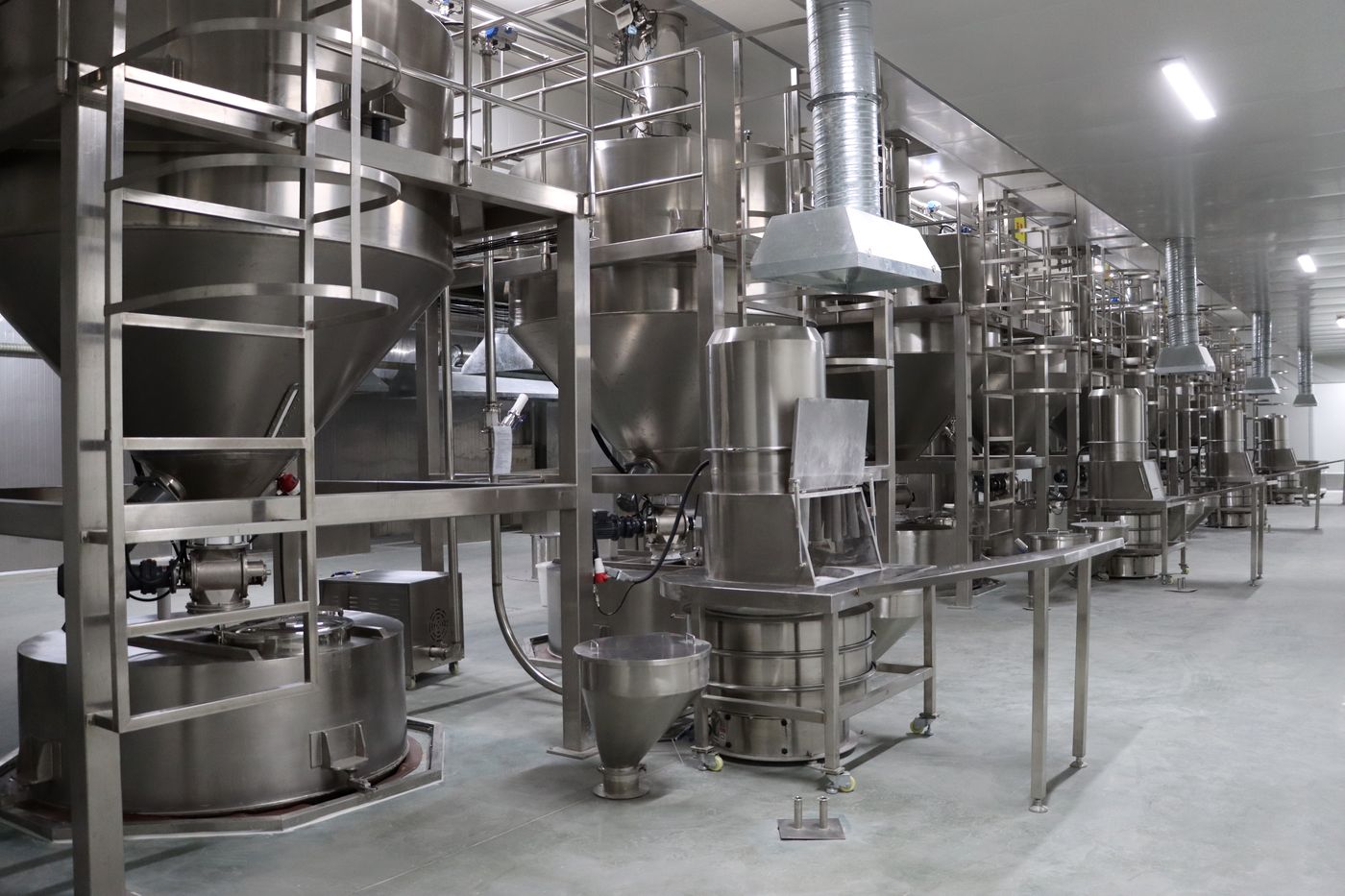
Yushengji Food Ingredients operates a compound seasoning and marinade manufacturing facility in Shandong, China, supplying chicken marinades, coating powders and batters, sprinkle-on seasonings, sauces and functional ingredients to food factories in Indonesia, Malaysia and the UK.
On the technical side, our recommended marination process for reconstituted chicken products is a defined sequence rather than a rule of thumb: chicken base 100, marinade 5–7, functional moisture-retention compound 0.3, acidity regulator 0.3, corn starch 5–8, ice water 10–15; then vacuum tumbling at −0.08 MPa for 50–80 minutes, marination at 0–4 °C for 8 hours or more, cooking, blast freezing at −28 to −30 °C to a core temperature of −18 °C, and packing. Written parameters like these are what make a trial reproducible and a comparison honest.
Our R&D team of more than 20 people works on OEM, ODM and flavour customisation, and our facility runs an annual single-shift capacity of 50,000 tonnes with 5,000 m² of warehousing for stock holding. We hold HACCP, ISO and Halal system certifications with adaptation support for MUI, JAKIM and BPJPH schemes — which matters if you are exporting into Indonesia, where the BPJPH Halal requirement has applied in full since 17 October 2026.
What we would say to any buyer running this checklist: ask us for the trial, on your chicken, with your parameters. That test is more informative than any brochure.

Certifications and compliance
Every certification below is documented and auditable. Certificate numbers and validity dates are listed so your audit or QA team can verify them directly with the issuing body rather than taking a brochure's word for it.
| Certification | Certificate no. | Issuing body | Valid until |
|---|---|---|---|
| BRCGS Global Standard for Food Safety, Issue 9 — Grade B+ | 4013 | CSI SpA (ACCREDIA accredited) | 10 Nov 2026 |
| IFS FOOD Version 8 — Foundation Level, score 93.89% | 4012 | CSI SpA (ISO/IEC 17065 accredited) | 7 Oct 2026 |
| ISO 22000:2018 Food Safety Management System | 001FSMS2300493 | CQC (China Quality Certification) | 18 Jul 2029 |
| HACCP System Certification (V1.0), food chain category CIV | 001HACCP2300562 | CQC (China Quality Certification) | 18 Jul 2029 |
| Halal — Indonesia Halal Law & MSI 500:2019, recognised by BPJPH and JAKIM | 7244240000 | SHC (Shandong Halal Certification Service) | 27 Jun 2027 |
| US FDA Food Facility Registration — status VALID | 12558545698 | US FDA (UFI 847392952) | 31 Dec 2026 |
BRCGS and IFS run on an annual unannounced audit cycle, so the two CSI certificates are re-issued each year; ISO 22000 and HACCP are three-year certificates with annual CQC surveillance audits. Alongside the six certifications, the plant holds the Export Food Production Enterprise registration (No. 4000/17071) issued by Weifang Customs for compound seasonings and pre-mixed powders — the customs registration that makes direct export possible.
07Frequently asked questions
What is the most important factor when comparing seasoning suppliers?
Cooked yield on your own raw material. Everything else — price per kilogram, flavour quality, packaging — is downstream of how much saleable product you get from each kilogram of meat. A supplier who wins on yield can afford to look expensive on the quotation and still be the cheaper option.
Should I compare suppliers on price per kilogram?
Only as a final step, and only after normalising for usage ratio. A product used at 5% and one used at 7% are not comparable at the same price per kilogram. Convert everything to cost per finished kilogram first.
How do I verify a Halal certificate is valid for my export market?
Check the issuing body and the scheme, not just the word "Halal". Indonesia recognises BPJPH-issued certification, with the full requirement in force from 17 October 2026. Malaysia's JAKIM scheme carries wide recognition across ASEAN, the Middle East, South Asia and Africa. Ask your supplier which specific scheme applies to the product and facility you are buying from, and get the certificate document with the facility address on it.
What MOQ should I expect from a compound seasoning manufacturer?
It depends on the formulation and the packaging line, but be wary of any MOQ far above your monthly consumption. If it is, you are buying inventory risk. Ask instead whether a smaller trial quantity is available for validation before committing to a production run.
How many sample rounds should a custom seasoning project take?
Plan for a defined sequence rather than a number: brief and target definition, first sample, adjustment round, application trial on your line, and approval. Projects that skip the application trial on real equipment tend to fail at scale-up rather than at tasting.
Can I switch seasoning suppliers without reformulating my product?
Sometimes, if the new supplier can match your existing sensory and physical baseline within your tolerance. The practical route is to give the new supplier your current product as a reference and a written baseline, then verify with a side-by-side trial. See our guide on switching suppliers without changing taste.
What should I test during a sample evaluation?
Cooked yield, colour after marination and after cooking, texture after freeze–thaw and reheating, water purge on thawing, and flavour intensity at your actual usage ratio. Measure rather than discuss. A written record of these five points turns a subjective argument into a decision.
Does a large production capacity guarantee reliable supply?
No — capacity guarantees nothing unless it is measured against your demand at your peak. Ask how much of the stated capacity is already committed, and what lead time the supplier can hold during the season when you need it most.
What technical support should a seasoning supplier provide after the order?
At minimum: a named technical contact, help adjusting usage ratios to your line, troubleshooting when a batch behaves unexpectedly, and periodic consistency checks. If support stops at delivery, the supplier is a trading company in all but name.
How often should supplier performance be re-evaluated?
Once per quarter on the operational points — batch tolerance, lead time adherence, complaint rate — and annually on the full checklist including certificate validity and capacity fit. Certificates expire and capacities tighten; an annual review catches both before they interrupt your line.
Yushengji Food Ingredients (Shandong Yushengji Food Co., Ltd.) — Halal food ingredient and flavour solutions provider. Chicken marinades, coating powders and batters, sprinkle-on seasonings, sauces and functional ingredients for food factories. Annual single-shift capacity 50,000 tonnes · R&D team 20+ · BRC, IFS, ISO 22000, HACCP, Halal and US FDA-registered systems.
This article describes general procurement criteria. Verify all certification scope and compliance requirements against your specific destination market and product category.